
I’ve always been a car enthusiast. When I was younger I owned a 1998 BMW M3 which had a manual transmission. I refused to own a car that had an automatic transmission. I always and still do enjoy the extra effort and level of involvement a manual transmission car offers as compared to the convenience of an auto. However, as I’ve grown older and my tolerance for driving manual in dense urban environments has shifted, I’m not quite as black & white about the topic and drive a car with an auto now. Yet I still like to daydream about buying another manual transmission car.
The Problem
When I have a free moment, I often visit car auction websites just to window shop. One of the main sites I visit is called Bring a Trailer (BaT), which is a popular car auction website that specializes in classic, vintage, collector, and enthusiast cars. There’s always something interesting to find on there, which is why I visit. However, in the last few years I’ve found myself more often going to its competitors’ websites for a pretty simple reason: Bring a Trailer has no way to filter its listings by transmission. It is not uncommon for BaT to have over 1,000 active listings on its site, so using filters dramatically reduces the number of listings I’m not interested in seeing. My car enthusiast daydreams almost exclusively involve me driving a manual transmission car so every search on any listing site always starts with me checking the “Manual transmission” filter box.
What I Did About It
Having had enough of waiting for BaT to add the filter themselves, I decided one weekend to ask Claude to build me a simple bookmarklet that would filter the listings by transmission for me. A bookmarklet is a browser bookmark that, instead of taking you to a website, runs a small bit of code on the page you’re already on. So when I’m on BaT, I start the bookmarklet and the filter gets added right onto the page. It took a lot of back and forth to not only refine the accuracy but also refine the bookmarklet’s UI experience. By version 15, it was starting to feel pretty worked out.
How Does The Manual Transmission Bookmarklet Work?
1. Filter Categories
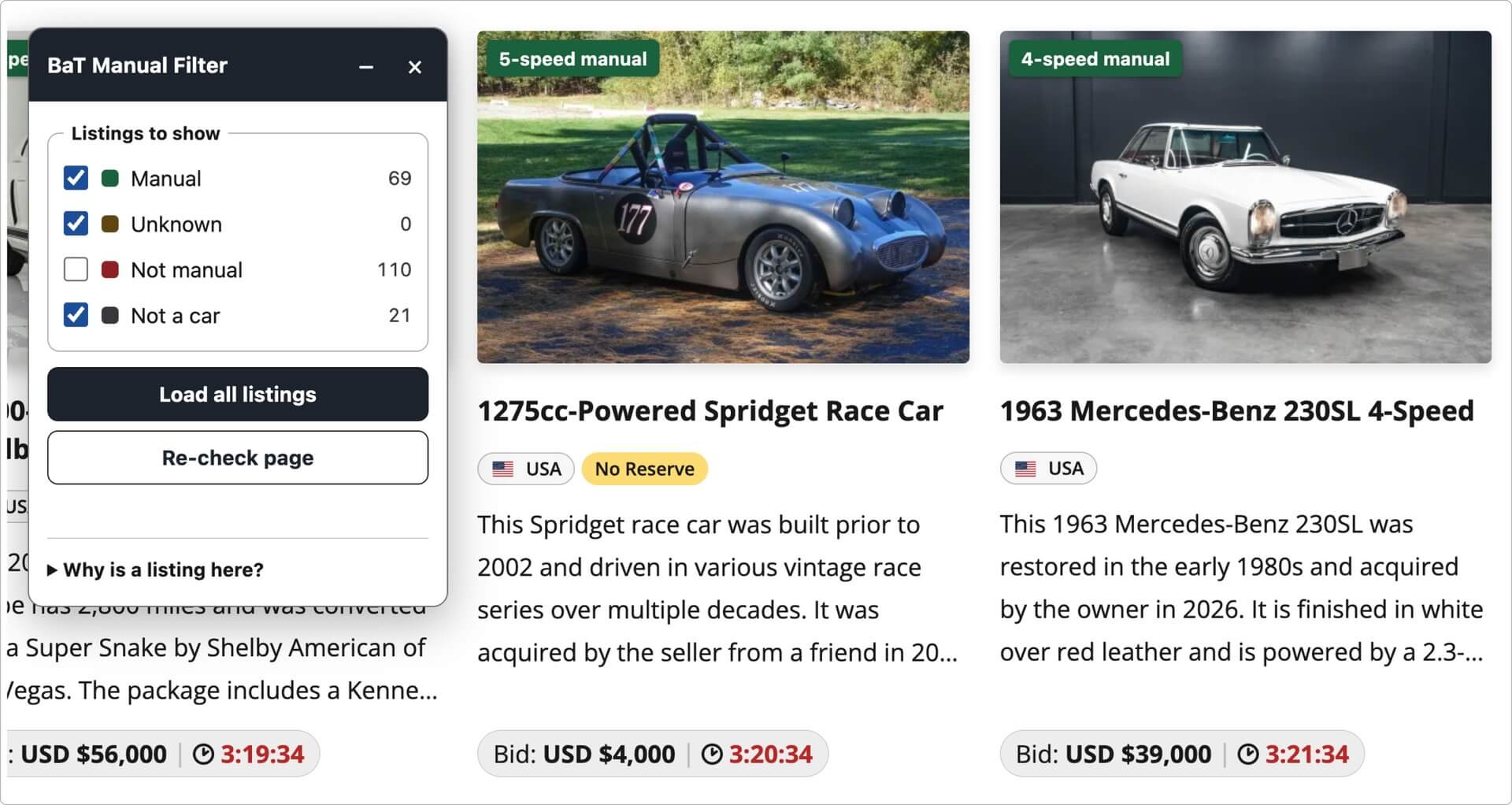
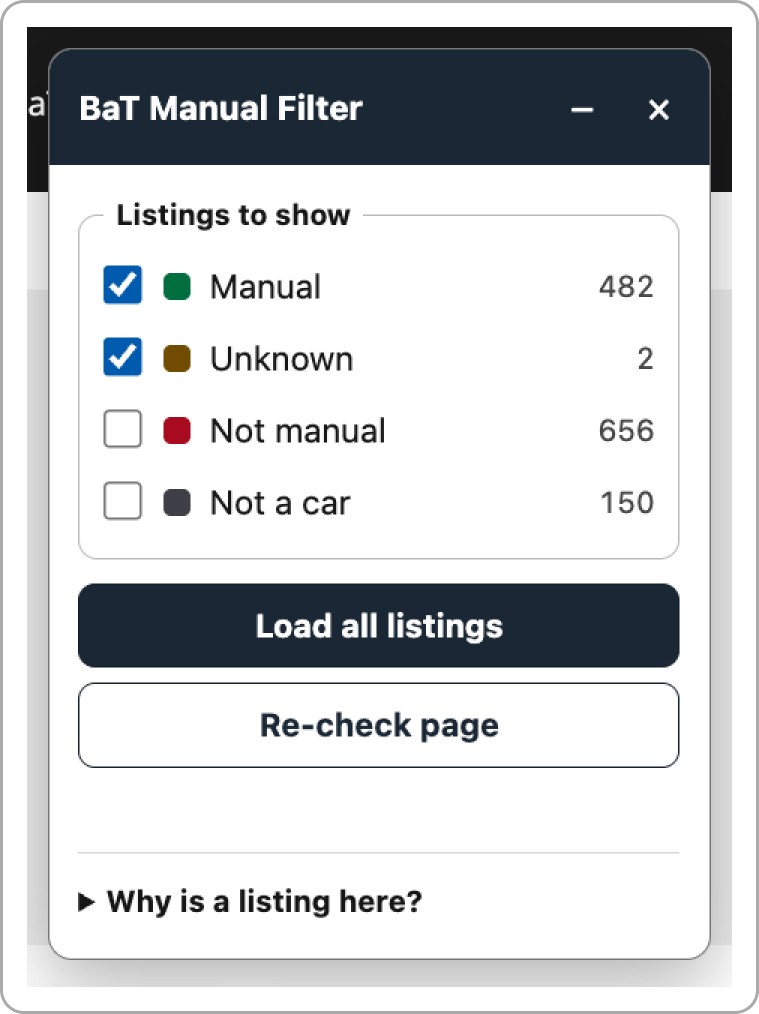
When the bookmarklet opens, it scans all listings on the page and groups them into four categories:
- Manual
- Not manual
- Unknown
- Not a car
Since this is for myself, and BaT already has a lot of other filter mechanisms, I chose to keep this simple and just focus on whether the listing is a manual transmission car or not.
2. Load All Listings
Since BaT’s listings are all on one page but the site doesn’t load all listings until you scroll down, I created an action to auto-scroll the whole page so the bookmarklet could check all the listings at once.
3. Individual Listing Badges
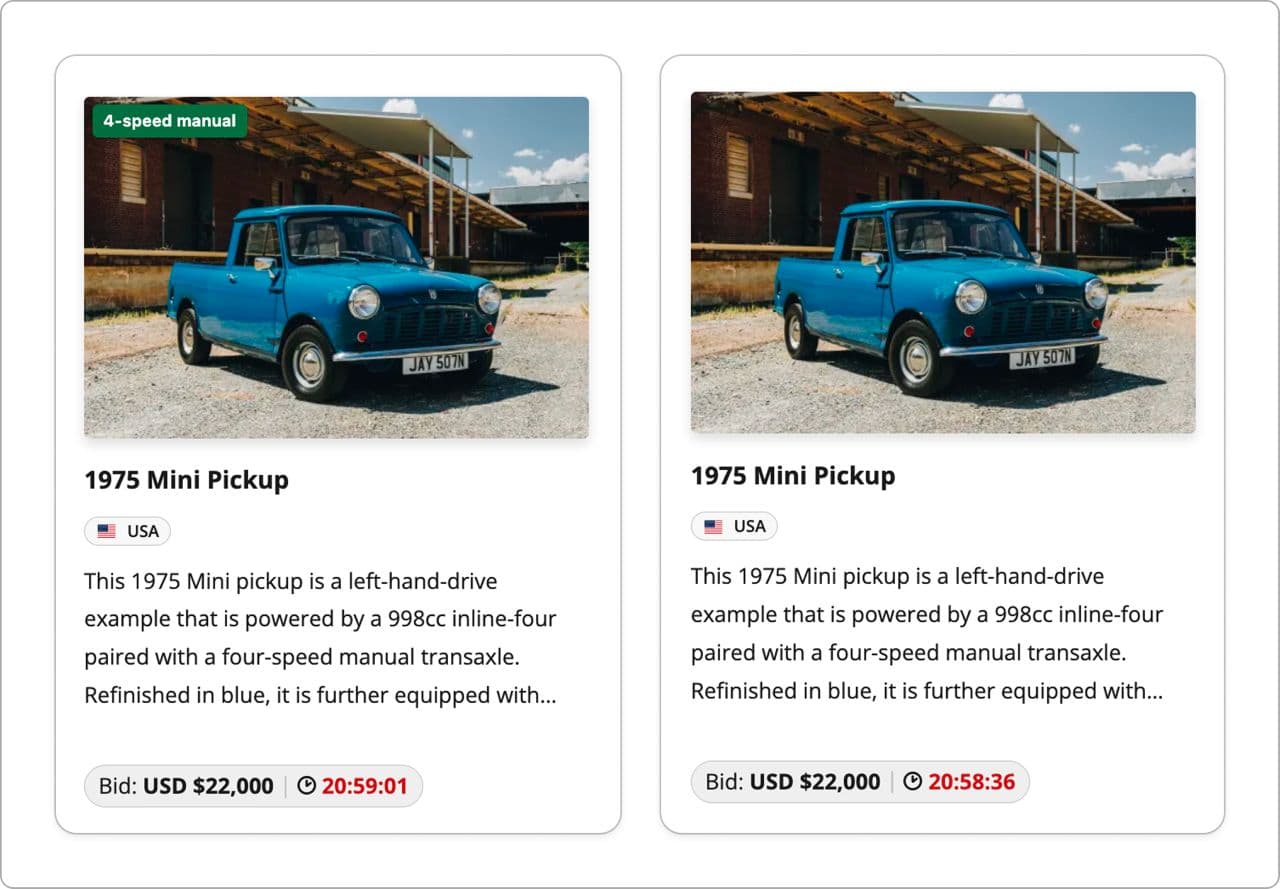
Once the tool classifies a listing, it adds a badge on the individual listing which communicates two things:
- Whether it’s a manual, automatic, not a car or unknown via its color and label
- Name the details of the transmission such as # of speeds
4. How Does The Tool Determine a Listing Is a Car That Is Manual Transmission?
It’s a Car
BaT already files every listing under its own categories. Many of those categories are not cars. Anything in Motorcycles, Parts, Wheels, Boats, Aircraft, All-Terrain Vehicles, Side-by-Sides, Go-Karts, Minibikes, Tractors or Trains becomes not a car. Campers and vans count as vehicles, so something like a Westfalia 4-Speed shows up. However, towable campers with no engine are set aside as not a car.
It’s a Manual
The tool uses three sources, in this order to verify the car’s transmission type:
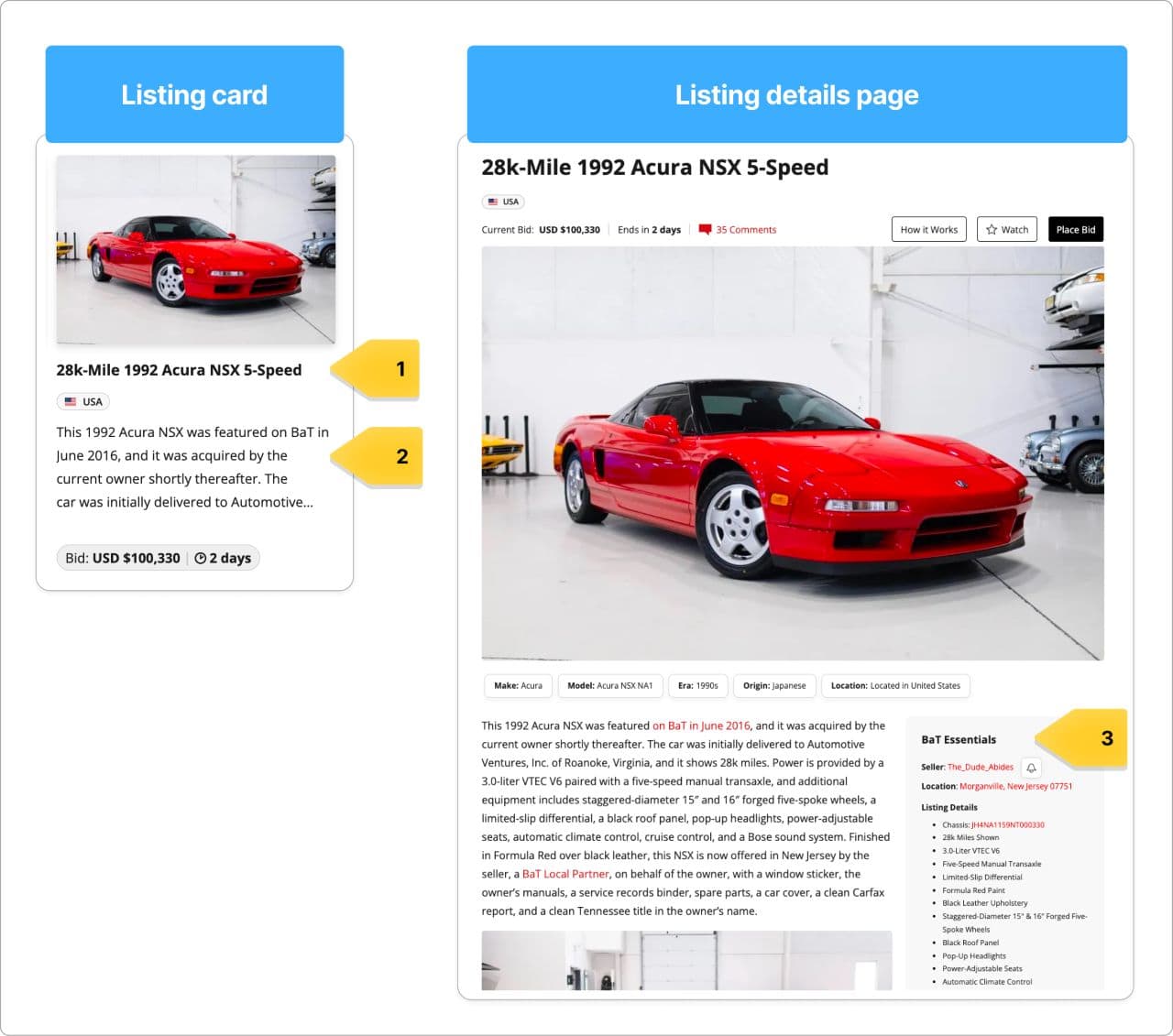
- Auction listing card title. BaT puts “5-Speed” or “6-Speed” in a car’s title only when it is a manual. However, this is an unwritten rule BaT does not follow for every manual car so it can’t be the only source.
- Auction listing card description which may describe the transmission but if it gets cut off just before the transmission type (ex. “through a seven-speed…”) the tool will need to further investigate.
- The listings details page, specifically the “BaT Essentials” section which has unlabeled bullet point details about the car, including the transmission type.
5. Why Is a Listing Here?
As I continued to refine the accuracy of the manual transmission checker, I added a way for the bookmarklet to explain how it deduced a result was a manual or not so I could continue refinement with Claude. If I were to publish this tool, I’d replace this function with a “report an issue” action since I don’t expect users to fix technical problems on their own.
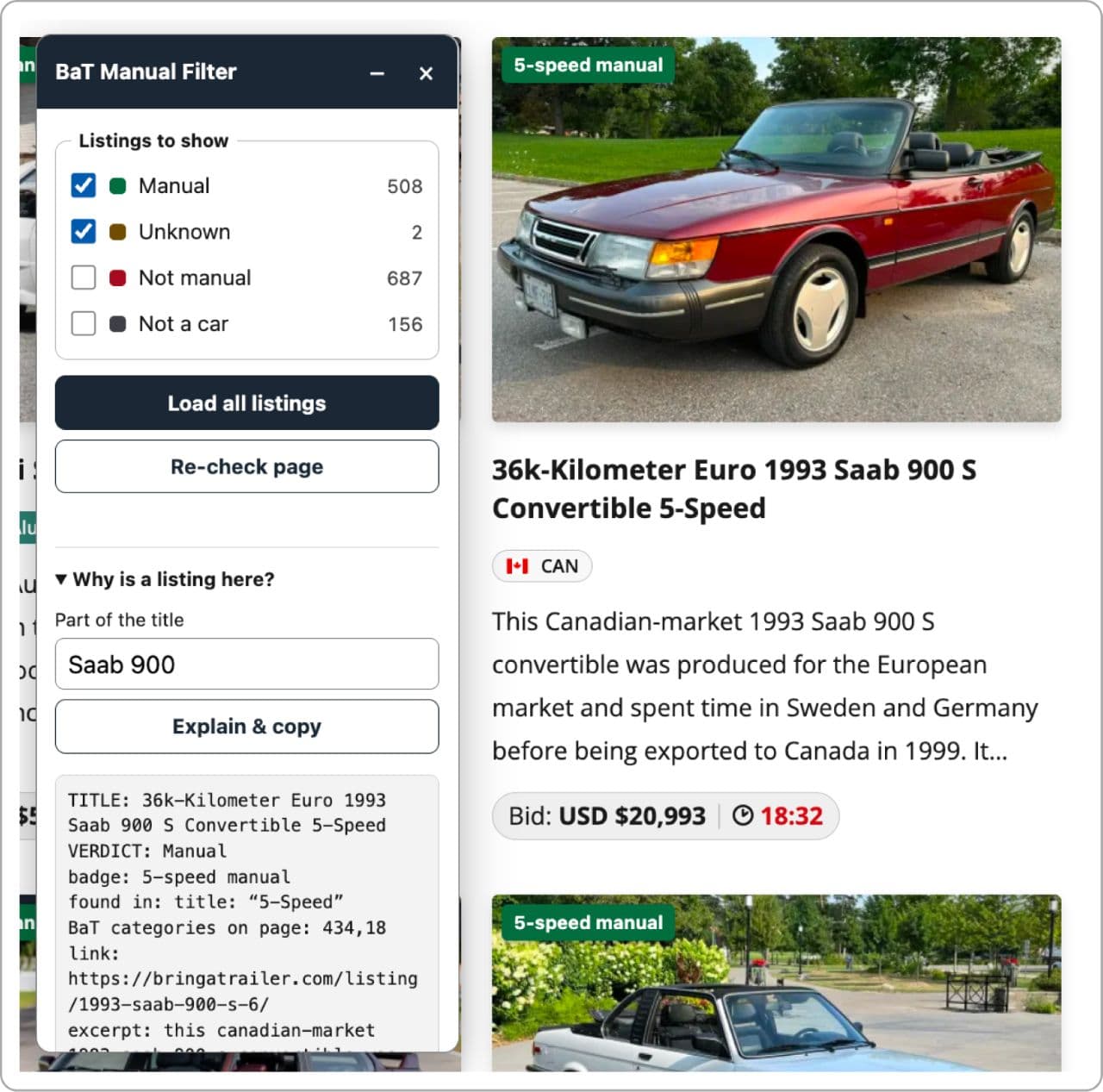
6. How Does Filter Work When There’s Listings That Aren’t Cars?
A small portion of listings on Bring a Trailer are motorcycles, boats, wheels, or parts. The bookmarklet uses the category tags Bring a Trailer already puts on every listing to move those into their own group, separate from the transmission sorting. So when I choose to see only manual cars, the non-cars drop out of the results. Bring a Trailer already records what is for sale, just not how it shifts.
Where Does This Tool Still Struggle?
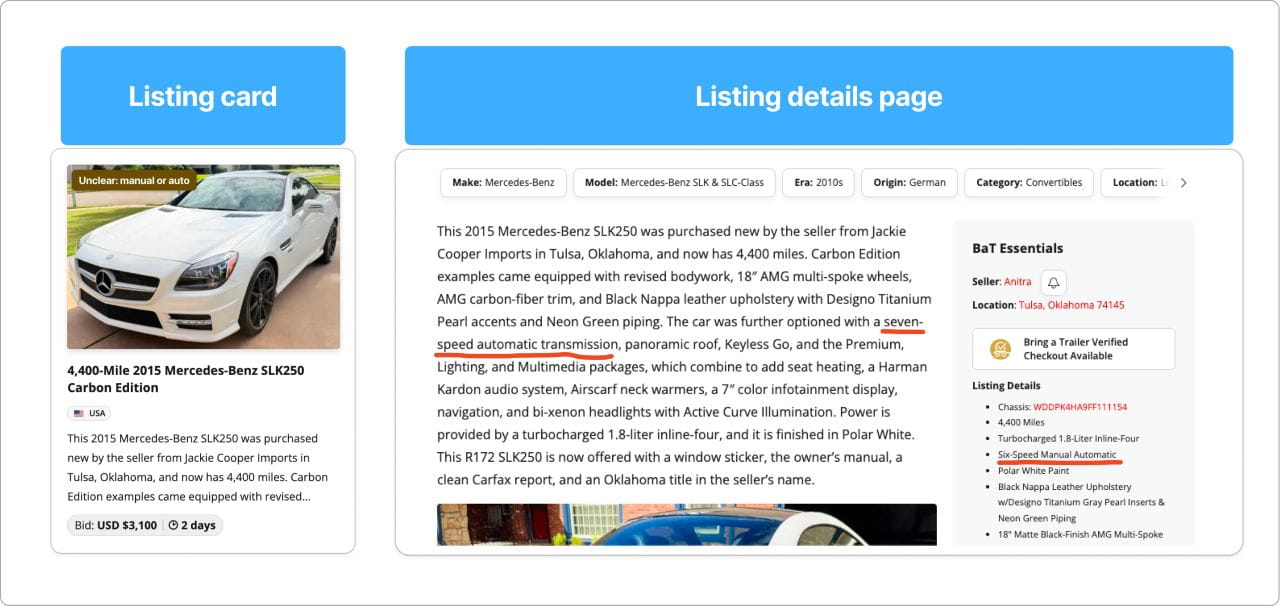
Even after 15 versions, there are still some listings the bookmarklet couldn’t figure out. One example is a 2015 Mercedes-Benz SLK250 that was listed on BaT. The title doesn’t mention the transmission at all. The listing details say it has a “Six-Speed Manual Automatic” transmission, and the description says it has a “seven-speed automatic”. So depending on where you look, you get two different answers.
As a human being, I can look at the two answers, review the pictures of the gear stick, or Google it and deduce that this car is an automatic. However, the bookmarklet can’t fix a listing that contradicts itself, so it marks it as Unknown. In this case, I’d rather the tool tell me it doesn’t know than guess wrong. More importantly, this example shows that the problem isn’t really the bookmarklet. The tool struggles because BaT never stores the transmission type anywhere. It’s only ever written out in sentences, and in this case it was written out wrong.
Comparison to Cars & Bids
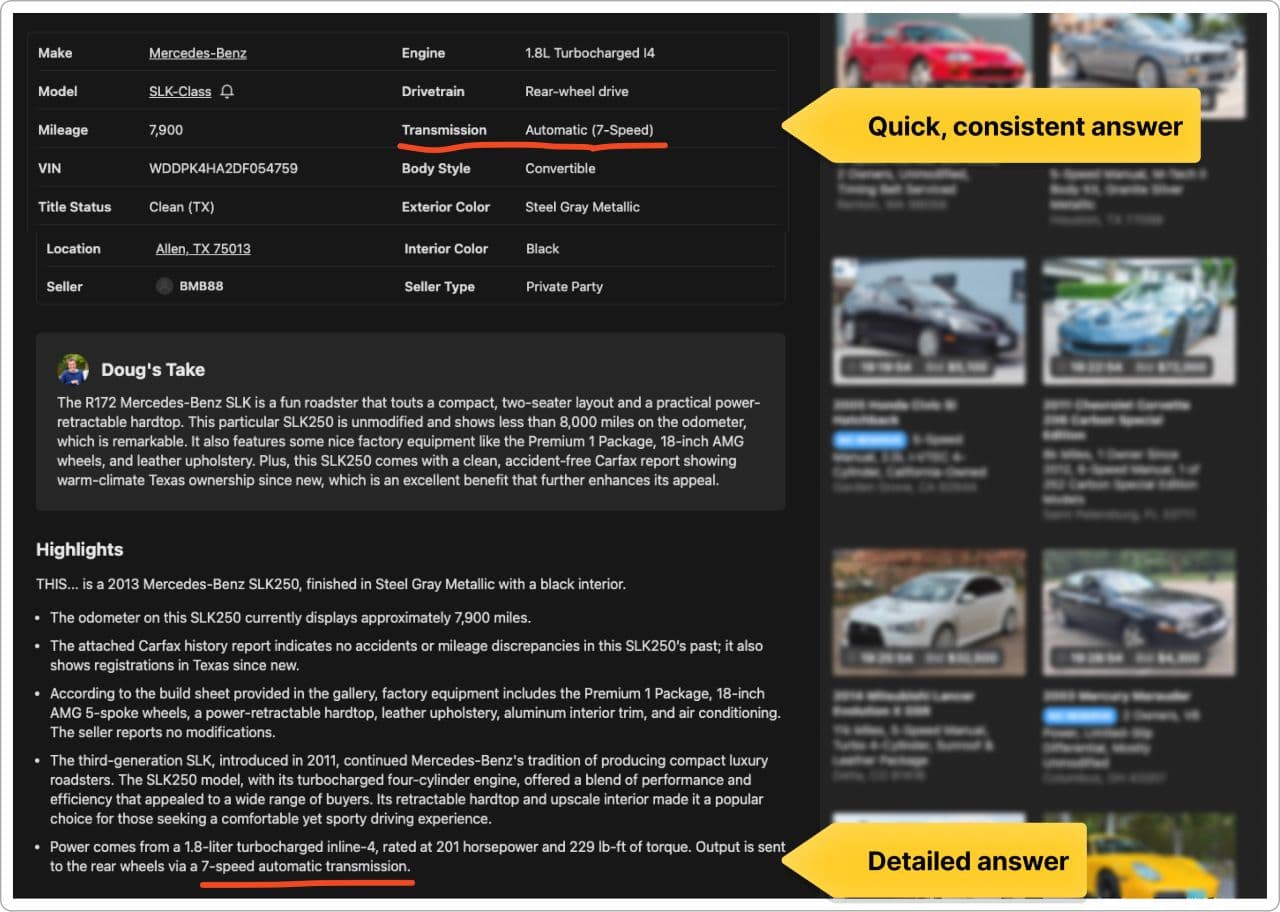
One of BaT’s biggest competitors, Cars & Bids (C&B), handles this much better. On C&B, every listing has a labeled row for the transmission in the same spot using the same content structure, such as “Transmission: Manual (6-Speed).” Since every listing uses the same two values (manual or automatic, plus the number of gears), C&B can turn that information into a filter. This also reduces mental load for readers by creating a consistent pattern they can rely on across listings.
C&B’s approach isn’t perfect though. Since there are only two options, cars like a dual-clutch Audi R8 or an SMG BMW M3 show up as “Automatic,” even though car enthusiasts would consider those pretty different from, for example, a CVT automatic. Their labels also don’t always match the exact language the automaker uses. However, the automaker’s exact language is still written out in the longer description for anyone who wants that level of detail. So the main question, manual or automatic, gets a quick and consistent answer, and the details are still there for enthusiasts who want them.
What I’d Do
If I were working on this at BaT and was tasked with introducing this feature, I’d start with how listings are created. When a listing is written, the writer would pick the transmission from a short list (Manual, Automatic or Other) and add the number of gears. This would create a controlled value since it can only be one of a few set options. Writers could still write out the transmission in the main description the way the automaker names it (such as “Getrag Five-Speed Manual Transaxle”), giving enthusiasts the specificity they want. I think of that as the rich label. The controlled value is for the system and the rich label is for people.
This is similar to what C&B already does with its labeled transmission row and longer description. Where I’d go a step further is having the two check each other. If the writer picks Automatic but the rich label says “Six-Speed Manual,” the system could flag it before the listing is posted. That would have caught the SLK250 example.
Once the transmission is stored this way, BaT could add a transmission filter and show the transmission details consistently on every listing.
Why Hasn’t Bring a Trailer Done This?
It’s fair to ask whether I’m making this sound easier than it is. There are a few real constraints to keep in mind, but none of them is a reason not to do it.
- Unusual Gearboxes. BaT’s catalog spans a century, and old cars bring gearboxes that don’t fit neatly into manual or automatic. For example, Model Ts use pedal-shifted planetary transmissions. In cases like this, someone just has to make a call (does a Model T count as manual?) and add an “Other” option for anything that doesn’t fit.
- A Huge Archive. BaT has 265,000+ past listings, each with its transmission written as a sentence. Going back through every one by hand would take a long time. However, since nearly every listing already names its transmission somewhere, a tool like my bookmarklet could read those sentences and make a first pass at tagging them. BaT could also start with new listings and tag the archive over time, since the filter matters most for live auctions.
- Accuracy. In live auctions, if a manual car doesn’t show up under Manual, it could lose bidders and rightfully upset the seller. For new listings, the check between the controlled value and the rich label I described above would catch mismatches so the writer can fix them before the listing is posted. For older listings in the archive, a tool like mine could find the ones where the transmission is unclear or contradicts itself, and a person could review and fix both the filter and the listing itself. And if something still slips through, BaT’s commenters already act as a safety net. On the SLK250 listing, several commenters pointed out the mismatch and tagged BaT, and the listing has since been corrected.
Why I Think This Matters
In most cases, I can figure out if a car on BaT is a manual. I check the title, skim the description, and if I still don’t know, I open the listing and look through the details. However, that’s a lot of unnecessary mental load for something other car listing sites solve with a filter, especially when BaT has over 1,000 active listings at a time.
This reminds me of the book Cognition in the Wild by Edwin Hutchins, which argues that people don’t just think in their heads, they think with the tools and environments around them. When the structure lives in the system, people don’t have to carry it in their heads. For BaT, that means storing the transmission as a consistent value so no one has to piece it together from the title, the description and the listing details themselves.
So, I’ll keep window shopping on BaT and daydreaming about my next manual. I’d just like the site to do a little more of the sorting for me.